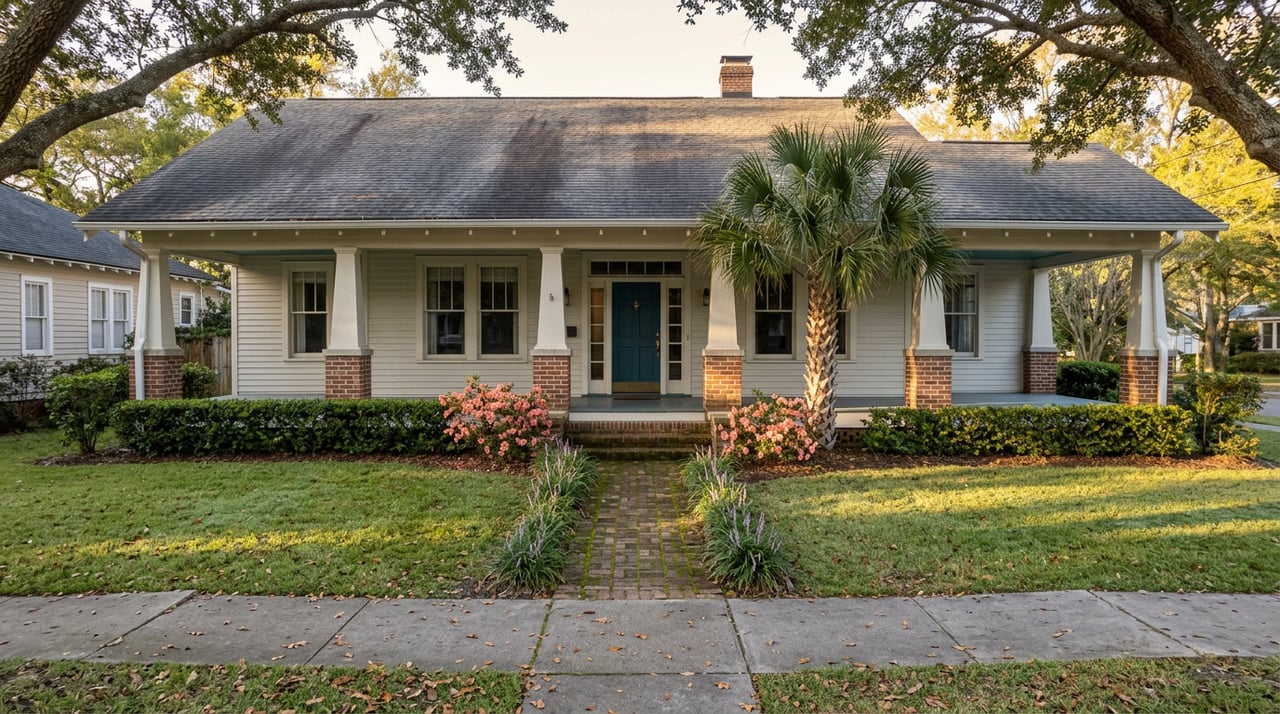
Picture two 1920s bungalows on adjacent streets in Tampa, both listed on the MLS with the same neighborhood tag: Seminole Heights. Same wood siding, same steep gable roofs, same age within a few years of each other. A buyer touring both assumes the renovation math will be identical too. It won't be. Depending on which side of an invisible boundary each house sits, one owner will need a Certificate of Appropriateness from Tampa's Architectural Review Commission before touching a window, a wall, or a roofline, and the other owner won't need to ask anyone's permission at all.
That boundary doesn't show up on a listing sheet. It shows up on a city map most buyers never think to pull, and it's the single biggest thing separating what "Seminole Heights" costs from what it actually lets you do once you own it.
Old Seminole Heights Contains Two Different Rulebooks
Greater Seminole Heights covers Old Seminole Heights, South Seminole Heights, and Southeast Seminole Heights, three neighborhoods under one umbrella name and sharing the bungalow-heavy building stock from the area's original 1910s and 1920s development. Buyers researching the area usually stop there, treating the name as one market. The split that actually matters happens inside Old Seminole Heights itself, where two separate historic districts sit blocks apart with two different levels of legal protection.
The Seminole Heights Residential District, roughly bounded by Hanna Avenue to the north, Osborne Avenue to the south, Florida Avenue to the west, and Cherokee Avenue and I-275 to the east, was listed on the National Register of Historic Places on August 5, 1993. Two years later, on March 16, 1995, the City of Tampa's Architectural Review Commission went a step further and designated it a Local Historic District, one of only four in the entire city, alongside Hyde Park, Tampa Heights, and Ybor City. That local designation is what triggers the review requirement. Anyone doing new construction, additions, or exterior repairs on a contributing structure inside that boundary has to apply for a Certificate of Appropriateness before work begins.
A few blocks away, still inside Old Seminole Heights, sits Hampton Terrace, originally platted as the Lakewood Manor subdivision and centered on the two-acre Lake Roberta. Hampton Terrace earned its own National Register listing on January 27, 1999, protecting roughly 470 contributing residences built between 1920 and 1931. But it never became a Local Historic District. It isn't one of the city's four. Which means a Hampton Terrace homeowner can replace windows, re-side a wall, or build an addition without ever filing a Certificate of Appropriateness application, while a Seminole Heights Residential District homeowner three streets over has to clear that review first for the same kind of project.
The Fight That Decided It
This split isn't an oversight. Hampton Terrace residents actually debated pursuing local designation, and the debate got contentious enough that Creative Loafing covered it in depth. A longtime preservationist named Anne McDonald spent two years leading an all-volunteer committee gathering documentation to bring to the city, hoping to secure the same local protection Seminole Heights proper already had. A vocal group of neighbors pushed back, worried the designation would govern something as ordinary as replacing a window or repainting a house. Dennis Fernandez, Tampa's historical preservation manager at the time, summed up the tradeoff plainly.
"It enables a participation into the development of the area. So in order to get that control you have to lose some control of your own property."
The pushback held. Hampton Terrace remains National Register only today, which is exactly why the difference in renovation rules between it and the Seminole Heights Residential District still exists more than three decades after the local district was drawn.
| Seminole Heights Residential District | Hampton Terrace | |
|---|---|---|
| Boundaries | Hanna Ave (N), Osborne Ave (S), Florida Ave (W), Cherokee Ave / I-275 (E) | Hanna Ave (N), Hillsborough Ave (S), Nebraska Ave (W), 15th St (E) |
| National Register listing | August 5, 1993 | January 27, 1999 |
| Local Historic District status | Yes, since March 16, 1995 | No |
| Exterior work requires a Certificate of Appropriateness | Yes | No |
South Seminole Heights and Southeast Seminole Heights carry neither designation. Bungalows there can be just as old, just as charming on a porch tour, and completely outside any ARC review requirement.
The Median You See Depends on Which Line You're Standing Inside
This same fragmentation shows up in the price data, and it explains why the numbers you'll find for "Seminole Heights" contradict each other depending on where you look.
Over the three months ending March 2026, Seminole Heights as a whole posted a median sale price of $558,000, up 6.2% year over year. Narrow the lens to Old Seminole Heights specifically, and January 2026 figures put the median at $445,000, up 14.8% from a year earlier, with 76 homes sold that month compared to 55 the year before, and average time on market stretching to 67 days from 45. A separate estimate for the same Old Seminole Heights footprint, as of mid-2026, pegs the average home value closer to $375,000. Meanwhile Hampton Terrace's own neighborhood association describes values in its 115-acre district as now pushing toward $700,000, a striking climb from the $5,000 to $12,000 asking prices when Lakewood Manor's original bungalows went up in the 1920s.
None of these figures are wrong. They're measuring different slices of a neighborhood that only shares a name on paper. Citywide, for comparison, Tampa homes were listed at a median of $449,000 in August 2026, down 5% from a year earlier, with a median of 69 days on the market. Seminole Heights isn't tracking that citywide softening the same way everywhere at once, because it isn't one market to begin with.
For a buyer comparing two listings both labeled "Seminole Heights," that spread between $375,000 and $700,000 isn't market noise to average out. It's a signal to ask which specific pocket you're actually looking at, and what that pocket will let you do to the house after closing.
What This Means If You're Comparing Listings
If you're weighing a Seminole Heights bungalow, especially one you're planning to rehab, a few questions are worth answering before you write an offer:
- Which named sub-area is the parcel actually in? Old Seminole Heights, South Seminole Heights, and Southeast Seminole Heights are not interchangeable for renovation purposes even though they share a marketing name.
- Does the parcel fall inside the Seminole Heights Residential District boundary specifically? Tampa's Architectural Review and Historic Preservation Division can confirm this against their district maps, and it's worth a phone call before you assume anything based on the listing description.
- If it's inside the local district, build a Certificate of Appropriateness application into your renovation timeline. New construction, additions, and most exterior repairs go through the Architectural Review Commission before permits are pulled, and that review adds time a rehab budget needs to account for.
- If it's in Hampton Terrace, South Seminole Heights, or Southeast Seminole Heights, exterior work follows the standard city permitting process without that added review layer, though a National Register listing like Hampton Terrace's can still open the door to historic tax incentive programs worth asking about for qualifying rehabilitation work.
For anyone buying a distressed or inherited property in this part of Tampa with rehab plans already in mind, this is the kind of detail that changes a project timeline before the first contractor ever walks the lot.
A Few Questions Worth Answering Directly
Does painting my house a different color require approval inside the local district? Exterior color and material changes on a contributing structure inside the Seminole Heights Residential District can fall under ARC review depending on the specifics of the work. Call the Architectural Review and Historic Preservation Division before you paint if your property sits inside that boundary.
Are South Seminole Heights and Southeast Seminole Heights historic districts too? No. The only Local Historic District within the greater Seminole Heights area is the Seminole Heights Residential District inside Old Seminole Heights. Neither South Seminole Heights nor Southeast Seminole Heights carries national or local historic designation.
Does National Register status without local designation, like Hampton Terrace has, do anything for a homeowner? It can make a property eligible for certain historic tax incentive programs the city and state administer for qualifying rehabilitation work. It does not require Architectural Review Commission approval before exterior changes, which is the practical difference that matters most day to day.
Seminole Heights rewards buyers who ask specific questions instead of trusting a single neighborhood label, especially if a rehab or a rental conversion is part of the plan. If you're weighing a bungalow here, or trying to figure out which pocket of Tampa actually fits what you want to do with the property, Tabatha Pankop has walked this exact boundary with buyers and investors before and can help you figure out which side of it you're standing on before you write an offer.